
Protecting Electronic Control Units in Long-Term Storage
Last Updated: 22 November 2026
Quick Summary
ECU storage works best in a stable, dry, static-safe space with steady temperature, low humidity and no rapid swings. Keep units in layered anti-static packaging with a desiccant sachet, label each bag with its seal date, and run a scheduled inspection checklist before any unit is issued or refitted.
- Stability of temperature and humidity matters more than any single reading in ECU storage.
- Use earthed wrist straps and anti-static mats, and keep units bagged until fitting.
- Store newest stock at the back and oldest at the front, reviewing flagged items before their date.
- Check bag seals, desiccant condition, corrosion and bent connectors on a schedule, not only after failures.
- A managed, climate-controlled store holds conditions steady and keeps records your own stores area may lack.
Table of Contents
- What Goes Wrong When Electronic Control Units Sit in Storage
- ECU Storage Conditions That Keep Circuit Boards Serviceable
- Choosing Anti-Static Packaging for Electronics
- Long-Term Storage of Electronic Components: Shelf Life and Rotation
- An Electronic Component Inspection Checklist for Stored Stock
- Why Climate-Controlled, Managed Storage Beats an In-House Stores Area
- Reviewing Your ECU Storage Arrangements with HubXpert
- Frequently Asked Questions
What Goes Wrong When Electronic Control Units Sit in Storage
An electronic control unit is a sealed module of circuit boards, connectors and memory that runs a machine's core functions, and it fails in storage for reasons that have nothing to do with age alone. Moisture, heat cycles and static discharge all attack a unit while it sits on a shelf doing nothing.
That is the part most stores areas miss. A unit that worked when it came off the line can be scrap by the time it is needed.
The failures are rarely dramatic. They are slow and quiet:
- Corrosion on connectors. Damp air settles on exposed pins and terminals.
- Cracked solder joints. Repeated warm and cool cycles stress the board.
- Memory loss. Some units lose stored settings without a stable environment.
- Static damage. A single careless handling event can kill a board.
The result is a spare that looks fine, tests badly, and delays a repair. Below, we set out the storage conditions that actually protect these units, the packaging that helps, and how to check stock before you need it.
ECU Storage Conditions That Keep Circuit Boards Serviceable
ECU storage works best in a stable, dry, static-safe space with steady temperature, low humidity and no rapid swings. Stability matters more than any single reading.
Humidity and Temperature Limits Worth Working To
Keep relative humidity low and steady, and temperature free of wide swings. A stable band with no sudden changes is the aim, and the right range depends on the maker's guidance for each unit.
The key point is the dew point. When warm, damp air meets a cold board, moisture forms on the surface (Damp, mould and condensation in the home). That is what corrodes pins and tracks.
- Keep units away from external walls and doors.
- Never store near heaters, skylights or loading bays.
- Log the readings, so you can prove conditions held over time.
- Watch out: a stores area that is dry in summer can be damp in winter without anyone noticing.
ESD Protection and Handling Discipline
Electrostatic discharge is a sudden flow of static electricity between two objects. It can destroy a circuit board without any visible sign.
Handling is where most damage happens. A technician in a dry room, wearing a synthetic fleece, can carry enough charge to harm a board.
- Use earthed wrist straps and anti-static mats at the bench.
- Keep units in their protective bags until the moment of fitting.
- Never slide a board across a bench or carpet.
- Train anyone who touches stock, not just engineers.
Choosing Anti-Static Packaging for Electronics
Anti-static packaging for electronics should shield the board from static, block moisture and survive handling without splitting. The right choice is a layered approach, not a single bag.
Match the packaging to the risk:
- Moisture-barrier bags with a desiccant sachet for long holds.
- Pink anti-static bags for short-term protection and general handling.
- Black conductive bags where static risk is high.
- Rigid boxes or trays to stop physical flexing and pin damage.
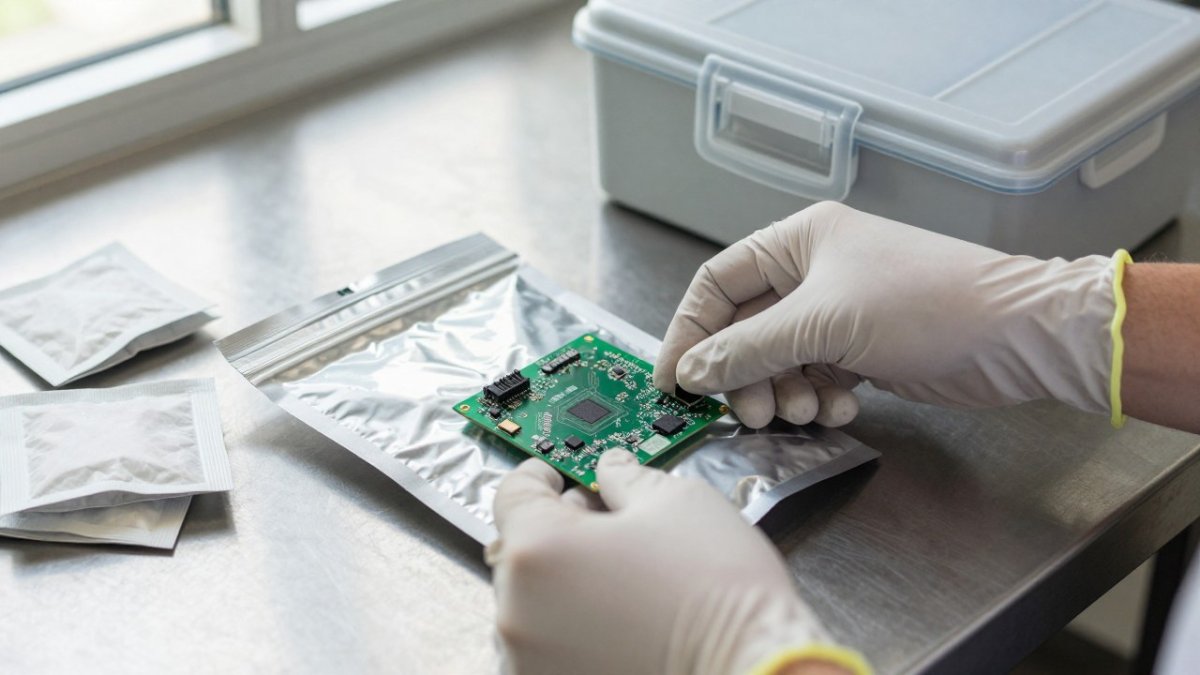
Label each bag with the date it was sealed. An unlabelled bag tells you nothing about how long it has been there.
Match the packaging to the risk, using a layered approach rather than a single bag.
| Packaging option | Best for | Key difference |
|---|---|---|
| Moisture-barrier bags with desiccant sachet | Long holds | Blocks moisture as well as static |
| Pink anti-static bags | Short-term protection and general handling | Basic anti-static protection |
| Black conductive bags | Where static risk is high | Conductive rather than anti-static |
| Rigid boxes or trays | Stopping physical flexing and pin damage | Physical protection, not static shielding |
Long-Term Storage of Electronic Components: Shelf Life and Rotation
Long-term storage of electronic components needs a shelf-life date, a rotation rule and a record of where each item sits. Without those three, stock quietly ages out of use.
Some units carry a recommended storage period from the maker, and others do not. Where no date is given, set your own review interval and stick to it.
A simple rotation rule works well:
- Store newest stock at the back, oldest at the front.
- Review flagged items before their date.
- Test a sample from long-held batches.
- Record the result against the item.
Our inventory management service is built around stock visibility and lifecycle control, which is where this kind of rotation discipline sits.
An Electronic Component Inspection Checklist for Stored Stock
An electronic component inspection checklist should confirm condition, packaging and records before any unit is issued or refitted. Run it on a schedule, not only when something fails.
Use this as a starting point:
- Check the bag seal and desiccant condition
- Look for corrosion, discolouration or residue on pins
- Inspect for cracked housings or bent connectors
- Confirm the storage date and shelf-life label
- Verify the unit against its record and location
- Test a sample where the maker allows it
- Note the result and re-seal in fresh packaging
Packaging and preservation are part of our storage work, and our value added services cover that side of stored stock.
Why Climate-Controlled, Managed Storage Beats an In-House Stores Area
A managed, climate-controlled store beats an in-house stores area because it holds conditions steady, keeps records and removes the daily pressure on your own team. An in-house shelf is only as good as the room around it.
Most stores areas are shared spaces. Doors open, forklifts pass, and the heating follows the building, not the stock. That is where stability breaks down.
A managed store can give you:
- Secure industrial storage with stock records of what is held and where
- Packaging and preservation alongside storage
- Digital traceability and inventory assurance
- Space that can scale with stock levels
You can see the storage side of this in our warehousing and storage service. The commercial case is straightforward. A failed spare can mean a delay, a rushed purchase and lost production time. Secure, well-managed storage helps protect the stock you already own.
Reviewing Your ECU Storage Arrangements with HubXpert
Good ECU storage comes down to three things: stable conditions, sound packaging and a record you can trust. Get those right and your critical spares stay serviceable until the day you need them.
If your stores area is shared, unlogged or simply full, it is worth a review. We can look at how your units are held, how they are packaged and how stock is tracked, then set out what would improve reliability.
We work with engineering, maintenance and stores teams on critical spares storage, stock accuracy and lifecycle control. If you would like to talk through your arrangements, get in touch and we will take it from there.
A failed control unit in storage is a repair delayed at the worst moment. HubXpert helps you hold critical spares in controlled, traceable conditions, with shelf-life tracking, stock rotation and clear records behind every item. Get started with HubXpert and keep your stored units ready for the day they are needed.
Frequently Asked Questions
How should electronic control units be stored long term?
Keep ECUs in a cool, dry space where temperature and humidity stay stable, and avoid areas prone to condensation or seasonal swings. Seal each unit in anti-static packaging with a moisture-absorbing sachet, label it with the receipt date, and store it off the floor on shelving. Record the location and inspection dates so stock can be checked on a fixed cycle rather than discovered by accident years later.
Should electronic control units be stored in anti-static bags?
Yes. Anti-static or static-shielding bags prevent the electrostatic discharge that can damage sensitive circuitry during handling and storage. Use bags sized to the unit so the seal is effective, and pair them with a moisture barrier where humidity is a concern. Avoid ordinary polythene bags, which offer no static protection and can trap condensation against the board.
How can moisture damage to electronic control units be prevented?
Moisture is the most common cause of storage failure. Control it by keeping relative humidity stable, using sealed barrier packaging with desiccant sachets, and never storing units directly on floors or against external walls where condensation forms. Check sachets and seals at each inspection.
How often should stored electronic control units be inspected?
Inspect on a fixed cycle, typically at least annually, and more often where storage conditions are less controlled. At each inspection check packaging integrity, look for corrosion, condensation or physical damage, confirm labels and dates are legible, and record the findings. A written electronic component inspection checklist keeps this consistent and gives you evidence of condition if a unit is later issued or sold.
