
A Practical Guide to Logistics Strategy for Retail Supply Chains
Last Updated: 10 November 2026
Quick Summary
A logistics strategy for retail supply chains is the set of deliberate choices about where stock sits, how it moves, and what happens when something goes wrong. It settles six decisions: network design, inventory positioning, fulfilment model, service promise, returns route and control layer. Everything else, from carrier negotiation to packaging, follows from these.
- Channel mix changes the inventory question, not just the delivery question, so allocation rules must be explicit.
- Scan at every movement and use reason codes on every adjustment to keep stock records honest.
- Cycle counting beats the annual stocktake: count a rotating sample, investigate variances and fix the process.
- Decide, for each channel, which two of speed, cost, availability and returns you will protect.
- Outsourcing does not transfer accountability for your customer promise; governance and review rhythm stay with you.
Table of Contents
- What a Logistics Strategy for Retail Supply Chains Actually Decides
- Matching Strategy to Retailer Size, Channel Mix and Product Profile
- Retail Inventory Management: The Accuracy Problem Behind Most Failures
- Retail Supply Chain Visibility and the Cost of Not Knowing
- Retail Fulfilment Strategy: Warehouse, Carrier and Returns Design
- Retail Logistics Best Practices That Survive Peak Season
- Resilience, Sustainability and the KPIs That Prove Progress
- Deciding Whether to Outsource Warehousing and Fulfilment
- Frequently Asked Questions
What a Logistics Strategy for Retail Supply Chains Actually Decides
A logistics strategy for retail supply chains is the set of deliberate choices about where stock sits, how it moves, and what happens when something goes wrong.
The decisions a logistics strategy settles are narrower than most guides suggest:
- Network design. How many stock locations you hold, and where they sit relative to your customers and suppliers.
- Inventory positioning. Which lines are held centrally, which are held forward, and which are ordered to demand.
- Fulfilment model. Whether picking and despatch run in-house, outsourced, or in a hybrid split by channel.
- Service promise. The delivery speed and accuracy you commit to, and the cost you accept to hit it.
- Returns route. How goods come back, who inspects them, and whether they re-enter stock.
- Control layer. The data, ownership and reporting that keep all of the above honest.
Everything else, from carrier negotiation to packaging, follows from these. Get the six right and the operational detail tends to look after itself.
Below, we set out how to match strategy to your business, where accuracy and visibility break down, and how to decide whether to keep fulfilment in-house or hand it to a specialist partner.
Matching Strategy to Retailer Size, Channel Mix and Product Profile
The right logistics strategy depends far more on your shape than your sector. A single-channel retailer with fast-moving stock needs something quite different from a manufacturer selling spares alongside a direct-to-consumer range.
Use this as a starting filter:
| Retailer profile | Priority | Typical model | Main risk |
|---|---|---|---|
| Small, single channel | Cost control | In-house with shared storage | Space runs out at peak |
| Growing, multi-channel | Accuracy and visibility | Hybrid or outsourced fulfilment | Stock split across channels |
| Manufacturer moving to DTC | Separation of flows | Trade stock and DTC stock held distinctly | Consumers competing with trade orders |
| Established brand, high returns | Reverse logistics | Outsourced with dedicated returns process | Returns value lost to poor inspection |
Product profile matters as much as size. High-value, slow-moving lines justify secure, closely governed storage; fast-moving consumer lines justify forward positioning and rapid replenishment; long-lead-time components justify deliberate buffer stock rather than reactive.
What most guides miss is that channel mix changes the inventory question, not just the delivery question.
Retail Inventory Management: The Accuracy Problem Behind Most Failures
Retail inventory management is the discipline of keeping recorded stock and physical stock in agreement, so that availability, ordering and financial reporting all rest on the same truth.
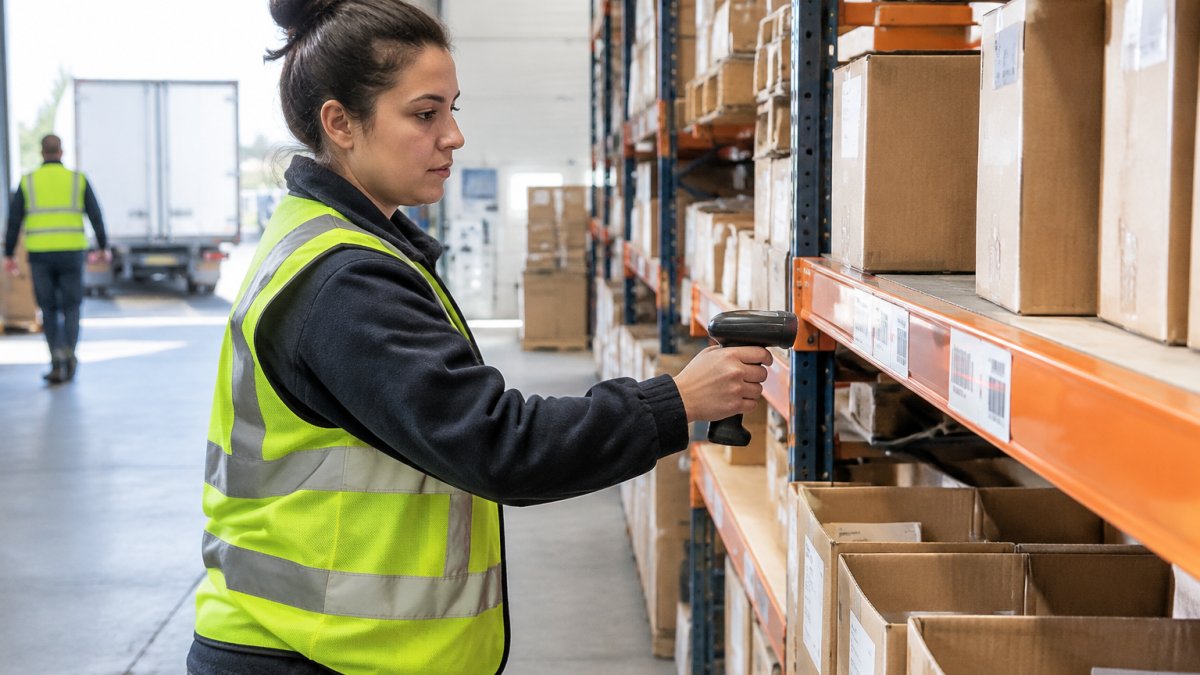
Accuracy rarely fails in one dramatic moment.
A common mistake is treating stock accuracy as a counting problem. More stocktakes do not fix it. The fix is process design, and in practice that means five controls working together:
- Scan at every movement. Receipt, put-away, pick, despatch and return should each generate a scan against a defined location. Paper lists and memory-based picks are where drift begins.
- Define and enforce locations. Every line has one home, and every home has a label. Mixed or informal locations make a pick error invisible until a customer finds it.
- Control issue and return. Spares and components drawn for maintenance or trade use need a recorded issue, not a note on a pad. Returns need a defined inspection point and a decision before goods re-enter stock.
- Use reason codes on every adjustment. An adjustment without a cause is a lost lesson. Reason codes turn a correction into a signal about which process is failing.
- Name an owner. Accuracy needs a named person accountable for the measure, reviewed on a fixed rhythm. Without an owner it becomes everyone's problem and no one's responsibility.
Cycle counting is the practical alternative to the annual stocktake.
Accuracy also has a product-lifecycle dimension that general retail guides tend to skip.
Measurement is where the discipline proves itself.
The control layer is the starting point for any inventory review, because availability and cost both depend on it. Our inventory management service covers the control layer that keeps recorded and physical stock in agreement.
Retail Supply Chain Visibility and the Cost of Not Knowing
Retail supply chain visibility is the ability to see stock position, order status and inbound movements in real time, from a single reliable source.
The cost of not knowing is rarely stated plainly, so it goes unchallenged.
guidance from the Department for Business and Trade on supply chain resilience reinforces a practical point: visibility is a precondition for resilience, not a reporting nicety.
Systems integration is where most visibility projects stall.
Retail Fulfilment Strategy: Warehouse, Carrier and Returns Design
Retail fulfilment strategy covers three linked designs: how stock is stored and picked, how it is moved to the customer, and how it comes back. Each has its own trade-offs, and they interact. The mistake most operations make is optimising one in isolation and discovering the cost lands somewhere else.
Carrier management is a service-level decision before it is a price decision. Shipment consolidation reduces cost per parcel but can slow despatch and complicate cut-off discipline.
The trade-offs between speed, cost, availability and returns are real and cannot all be won at once.
Watch out: the most common fulfilment design failure is a warehouse laid out for the wrong order profile.
Where a client needs a physical footprint designed around these flows, our warehousing and storage capability covers the storage and handling side. Returns are a distinct problem, and our reverse logistics service sets out how goods are received back, inspected and routed.
Retail Logistics Best Practices That Survive Peak Season
Retail logistics best practices are the habits that hold under pressure rather than the ones that look tidy in a quiet month. Peak season is the test.
Three practices separate operations that cope from those that collapse:
- Plan capacity against forecast, not last year's average. Peak is a distribution problem, not a total-volume problem.
- Lock cut-off discipline early. Late orders accepted in the first week of peak create backlog that never clears.
- Pre-stage packaging and consumables. Running out of boxes is a self-inflicted delay.
Flexibility matters more than permanent expansion. Our guide to flexible warehousing for seasonal growth covers how to plan capacity and structure arrangements that scale without long-term lock-in.
Watch out: the most common peak failure is accepting orders you cannot pick because stock accuracy was already drifting before the surge began. Peak does not create the problem. It exposes it.
Resilience, Sustainability and the KPIs That Prove Progress
Resilience planning starts with concentration risk. A supplier network built on a single source for a critical line is efficient until it is not.
Sustainability now sits alongside cost in most retail logistics conversations. The measurable levers are transport mode and consolidation, packaging specification, warehouse energy, and returns handling.
Measurement is where strategy proves itself. A small set of retail logistics KPIs is more useful than a dashboard nobody reads:
- Stock accuracy, measured by location, not just in total
- Order accuracy, as a percentage of despatches
- On-time delivery, against the promise made, not an internal target
- Inventory turnover, by product category
- Forecast accuracy, reviewed monthly
- Fulfilment cost per order, split by channel
Pick the ones that map to your strategy, assign an owner to each, and review them on a fixed rhythm. A KPI without an owner is a number, not a control.
Deciding Whether to Outsource Warehousing and Fulfilment
Outsourcing warehousing and fulfilment is worth considering when the constraint on your growth is operational capacity rather than demand.
In-house teams often reach a ceiling that has nothing to do with effort.
The decision criteria we would apply:
- Is stock accuracy a persistent problem? If yes, the control layer needs rebuilding, and that is easier to do with a partner who does it as a core discipline.
- Is your space adequate at peak but oversized for the rest of the year? A flexible arrangement usually beats a permanent lease.
- Are you splitting management attention between running a business and running a warehouse? That split has a cost, even if it never appears on an invoice.
- Do you have a genuine specialism, such as critical spares or promotional kitting? It needs a partner who understands it, not a generalist who will learn on your stock.
A word of caution: outsourcing does not transfer accountability for your customer promise. The governance, reporting and review rhythm still belong to you.
If you are at that decision point, get in touch to talk through your stock profile and constraints.
The commercial case for a specialist partner is straightforward.
Frequently Asked Questions
What is a logistics strategy in a retail supply chain?
It is the set of decisions that determine how stock moves from supplier to customer: where inventory is held, how often it is replenished, which carriers serve which postcodes, how returns are handled, and what data connects those stages. A retail logistics strategy is not a document for its own sake. It fixes the trade-offs between delivery speed, product availability, operating costs and returns. Retailers without those trade-offs written down tend to make them by accident, usually at the point a customer is already waiting for an order.
How can retailers improve supply chain visibility without replacing their systems?
Start with the gaps rather than the software. Map each handover point, from goods-in through picking to carrier collection, and note where stock status is recorded only on paper or in a spreadsheet. Most visibility failures sit at those handovers, not in the core platform. Adding a scanning step at goods-in and at dispatch, with one shared reference for each order, closes many of them. Retail supply chain visibility improves fastest when the data model is consistent, even before any integration work begins.
How can retailers improve inventory accuracy across their supply chain?
Accuracy comes from discipline at receipt, issue and return, not from counting more often. Record every movement at the point it happens, keep locations fixed and labelled, and separate quarantine or damaged stock from saleable stock. Cycle counting a small number of high-value or fast-moving lines each week usually reveals more than an annual full count. Where third-party storage is involved, agree who owns each adjustment and how discrepancies are investigated. Retail inventory management improves when the process, not the software, is the control.
When should a retailer outsource warehousing or fulfilment?
The usual trigger is a mismatch between peak demand and fixed space. If you are paying for capacity you only need for a few weeks, or turning away orders because picking cannot keep up, an outsourced model is worth costing. The same applies when stock accuracy or dispatch errors are consuming management time that should go elsewhere. Outsourcing works best where volumes are predictable enough to plan and the provider can show how they handle your specific product profile. Ask any provider for a clear stock accuracy reporting method before committing.
How should retailers choose between centralised and regional warehousing?
A single central site keeps inventory in one place, which simplifies stock control and reduces holding duplication. Regional sites shorten delivery distances but split stock and increase the risk of the same line being overstocked in one location and short in another. The decision usually turns on order density, product range breadth and how much delivery speed your customers actually value. For many growing retailers, one well-run central warehouse with reliable carrier coverage beats two half-utilised regional sites. Model the total cost, including stock duplication, before deciding.
What role does technology play in retail logistics?
Technology should make an existing process visible and repeatable, not compensate for a process nobody follows. Barcode scanning at goods-in and dispatch, a warehouse management system that reflects real locations, and carrier integrations that return tracking data automatically cover most of what growing retailers need. Systems integration between the shop platform and the warehouse prevents the manual re-keying that causes both stock errors and late dispatches. Add capability in the order the errors appear, and measure order accuracy and on-time delivery before and after each change.
